I went to the hospital two months ago for a pain under and on the side of my left rib they told me it was costochondritis.pain still there..help me
Mild pain medication: Costochondritis usually goes away on its own, although in some cases it may last for several months or longer. Treatment focuses on pain relief. Use medications such as Ibuprofen (advil, motrin, others) and Naproxen (aleve) — can be purchased over-the-counter, stronger varieties are available by prescription
Costochondritis
This information may be useful if you have been diagnosed with costochondritis. If you have new or ongoing symptoms should visit your healthcare professional for advice.
When the costochondral joint becomes inflamed it can result in sharp chest pain and tenderness. These symptoms may develop gradually or start suddenly.
You or someone else has symptoms like:
- central chest pain or discomfort that doesn’t go away – it may feel like pressure, tightness or squeezing
- pain that radiates down the left arm, or both arms, or to the neck, jaw, back or stomach
- unconsciousness
- seizures or fitting
- difficulty breathing (snoring or rasping)
- rapid heart beat
- low or undetectable heart beat
- blue or pale tingling of knees, hands and lips
- chest pain and breathlessness, nausea, sweating or coughing up blood
- there’s been new significant trauma within the last 7 days, for example a fall from height or direct blow to the chest or ribs
- there’s a change in the shape of the ribcage like lumps or indentations
- you have an increased shortness of breath or new breathing difficulties
- your pain levels are preventing you from breathing deeply
- you’re coughing up blood
- you start to feel generally unwell
- tingling or burning sensation in the chest, neck or arm
About costochondritis
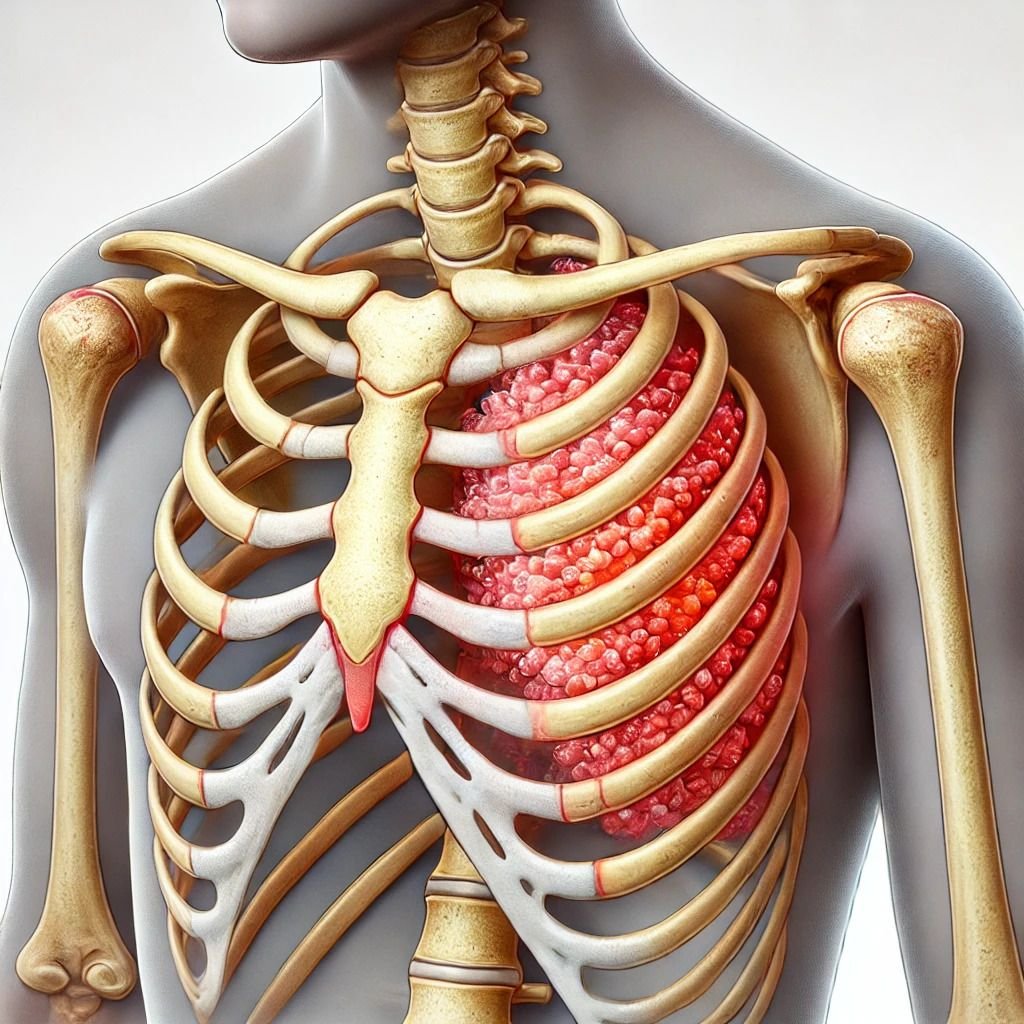
Costochondritis is the medical term for inflammation of the cartilage that joins your ribs to your breastbone (sternum).
Cartilage is tough but flexible connective tissue. It acts as a shock absorber, cushioning the joints.
Costochondritis will normally improve on its own after a few weeks but sometimes takes longer. The condition doesn’t lead to any permanent problems, but can occasionally flare up.
Symptoms of costochondritis
The main symptom of costochondritis is chest pain that appears centrally. The pain doesn’t usually spread across the chest or into the arms.
The pain may be made worse by:
- certain positions or activities, like wearing a seatbelt or hugging someone
- deep breathing
- coughing and sneezing
Modifying your activities while you recover may help reduce your symptoms.
Causes of costochondritis
Inflammation is the body’s natural response to infection, irritation or injury.
It’s not known exactly why this area becomes inflamed but in some cases it’s been linked to:
- severe coughing which strains your chest area
- an injury to your chest
- physical strain from repeated exercise or sudden exertion that you’re not used to, such as moving furniture
- an infection, including respiratory tract infections (RTIs)
Diagnosing costochondritis
For costochondritis to be diagnosed you’ll need an assessment from a healthcare professional.
They’ll initially ask you questions and then carry out a physical examination.
You may sometimes need to have a further examination. This is to rule out other possible health conditions.
Treating costochondritis
Costochondritis often gets better after a few weeks. It’s often referred to as a self limiting condition. This means it can get better on its own over time. Self-help steps and painkillers can help manage your symptoms.
Costochondritis can be made worse by any activity that places stress on your chest area, for example strenuous exercise or repetitive movements.
Any movement that makes the pain in your chest area worse should be modified until the inflammation in your ribs and cartilage has improved.
Some examples of modified activity include:
- taking regular breaks
- changing your position regularly while sitting or lying down
- holding objects close to your body when lifting them
- hugging a cushion while you cough
Pain managemnt
Pain medication can help you move more comfortably, which can help manage your symptoms.
More about taking painkillers.
Treating with heat or ice
Using heat or ice on your chest and ribs can help reduce symptoms. Use a barrier, like a towel, to protect your skin from a burn. Never place heat or ice directly on your skin. Apply for no longer than 20 minutes at a time and leave a few hours between treatments.
How to avoid hot water bottle burns and scalds – Care of Burns in Scotland
When should I stop using heat or ice?
You should stop treating the area with heat or ice if you notice an increase in redness, discolouration or blistering of the skin.
Read more about burns and scalds
If you have any issues with circulation or sensation, you shouldn’t use heat or ice as a treatment for chest and rib pain.
Keeping active
It’s important to try to keep moving as normally as possible during your recovery. It’s best to avoid long periods of rest where possible.
You can try to increase your activity gradually to help your recovery.
Pacing your activity levels
Too much rest can slow down your recovery. As soon as you can, start moving and using the affected area.
Remember a little activity is better than nothing. Continue to stay within acceptable pain limits but you don’t need to be pain free. Aim to do a little bit more each day or every few days.
How to tell if you’re moving at the right level
This guide can help you to understand if you’re pacing your daily activities at the right level as you progress. It’ll also let you see how much pain or discomfort is acceptable.
It can be helpful to rate your pain out of 10 (0 being no pain, 10 being the worst pain you’ve ever had), for example:
- 0 to 3 – minimal pain
- 4 to 5 – acceptable pain
- 6 to 10 – excessive pain
Pain during and after activity
Activity should not make your existing pain worse overall. Increasing activity can lead to increased discomfort as your body gets used to regaining your activity levels.
Aim to keep your pain within a rating of 0 to 5. If your pain gets above this level, you can change the level of activity by:
- reducing the number of times you do a movement
- reducing the pace of an activity
- increasing rest time between activities
Work
Costochondritis can sometimes mean you need to take some time off work to help recovery. How long you’re off will depend on your costochondritis and your role at work.
You don’t need to be symptom free before you consider returning to work. Continuing to go to work, or returning to work as soon as is possible for you, will help your recovery.
Gradually getting back to your normal daily activities can help to build up your strength and stamina levels.
Hobbies and interests
Keep doing any activities you’re able to, as your pain allows. Gradually increase what you do.
Your symptoms may make things more difficult to start with. This will get better as you slowly build up to all of your usual activities.
Help and support
Following this advice, you should see gradual improvements over time.
Talk to a healthcare professional if:
- your symptoms haven’t improved within 8 weeks following this advice
- your symptoms get worse
Find out about access to MSK services in your area
When dealing with any health condition it’s important to also look after your mental wellbeing. This can impact your recovery.
Understanding Costochondritis
What Is Costochondritis?
Costochondritis (pronounced cos-toe-kon-DRY-tis) is inflammation of the cartilage that connects your ribs to your sternum. Your sternum (or breastbone) is the flat bone in the middle of your chest that protects your heart, lungs, and major blood vessels.
Costochondritis is one of the most common causes of chest pain. The pain can be severe, and some people will mistake it for a heart attack. But it’s typically harmless and usually goes away without any treatment. However, you should take any chest pain seriously, especially if your pain doesn’t get better in a couple of days. If you have chest pain, go to your doctor and get checked for heart disease.